Subproject 1: "Syncopated Modernity. On the Conception of Sound as a Temporalized Entity, 1890-1930"
Subproject I investigates the conception of sound as a temporalized entity. Temporalization addresses the (micro-) temporal organization of sound through media technologies and in musical practices from 1890 to 1930. Ragtime and jazz were the two musical genres to emerge in which the new (micro-) temporal organization of sound took hold, as they aesthetically foregrounded rhythmic shifts (syncopation) and micro-timing (micro-temporal variations of the beat, later known as "swing-feeling" or "groove"). The genesis of syncopated and micro-time aesthetics was not solely an "invention" of ragtime and jazz alone, it was also buttressed by new sound technologies. Subproject I focuses on the piano roll for automatic pianos to delve into these matters and seeks to connect these media technologies to the musical cultures that grew up around ragtime and jazz. By focusing on Germany and the USA, the subproject aims to reconstruct the transatlantic entanglements through which the temporalization of sound became a widespread and common feature in musical cultures in North America and Europe. It foregrounds the interplay between the popularization and success of the music of the Black diaspora in the Global North and the newly emerging sound technologies at the turn of the 20th century.
Automatic pianos, ragtime, and jazz serve as the starting points from which Subproject I traces the temporalization of sound on a more general level — as a characteristic element of modernity of the late 19th and early 20th century. It thus works towards a perspective on sound that is not limited to music alone. It can be observed how the "discovery" of and interest in the micro-temporal dimension (of sound) also played an important role in other fields such as aesthetics (the visual arts, photography, and dance), the sciences (psychology, quantum physics), the industrialized organization of labor, and social engineering (Taylorism, Fordism) as well as vernacular cultures of the time (leisure practices). The subproject thus takes up several threads, and connects them through the concept of temporalized sound. It attempts to show how modern societies at the dawn of the 20th century exhibited a strong tendency to re-think and re-structure divers and diverse cultural practices through novel forms of (micro-) temporal organization. Strong tensions and debates arose around questions of how social life should be re-thought and re-structured through new temporalities. The call for more productivity and efficiency in Taylorism and Fordism lead to rigid patterns of standardization, control, and precise timing (e.g., "scientific management", assembly line work), whereas ragtime and jazz celebrated "disorderly" jumps and "strange" displacements of time and accents (syncopations) as well as micro-rhythmic variations.
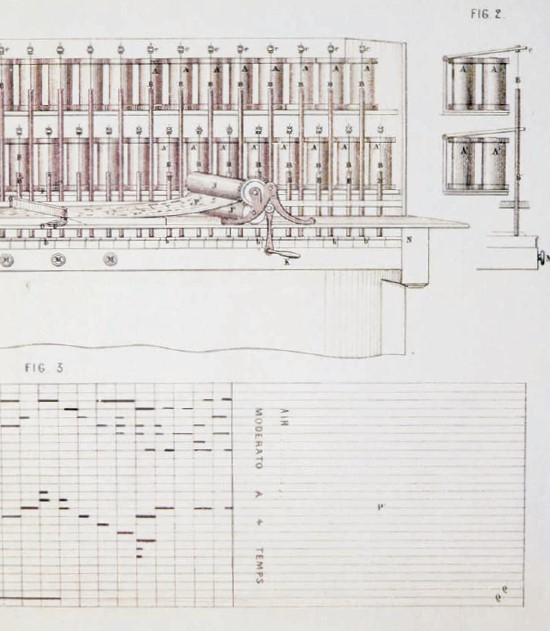
With the focus on piano rolls for automatic pianos, Subproject I focuses on a very specific medium: perforated paper. From the end of the 19th century onwards, perforated paper or card began to be used in many areas of society (e.g., punched cards for censuses, data processing in companies, the sciences) and it figured as a medium of standardization, efficiency, and, very importantly, time synchronization. As an enblematic technology of modernity’s will to rationalization, perforated paper was introduced for optimized and faster data processing (e.g., in statistics) or time control functions (e.g., operating in machines). In the field of music, the perforations on the paper of the piano roll also held the promise of coding and processing sound structures in reliable and standardized ways as well as enabling the production and dissemination of music on a mass scale. However, far from rendering music in an absolutely flawless way, the production and playback process (via the automatic piano) of piano rolls regularly produced peculiar errors, such as slight fluctuations in tempo caused by the material used in the piano rolls. Furthermore, skilled piano roll editors could also "manipulate" the "natural" flow of time through slight displacements of perforations, which offered the opportunity of moving single notes to various positions on the paper, thereby making micro-rhythmic deviations of time intelligible. The piano roll thus sonified a tension between (mechanical) standardization and the breakdown of a standardized (time) order. It embodied a "classic" technology of modern standardization, but also its exact opposite: the "failure" of standardization. Subproject I posits that this double articulation could be heard and played back via piano rolls and was most prominently foregrounded in the repertoires of ragtime and jazz.
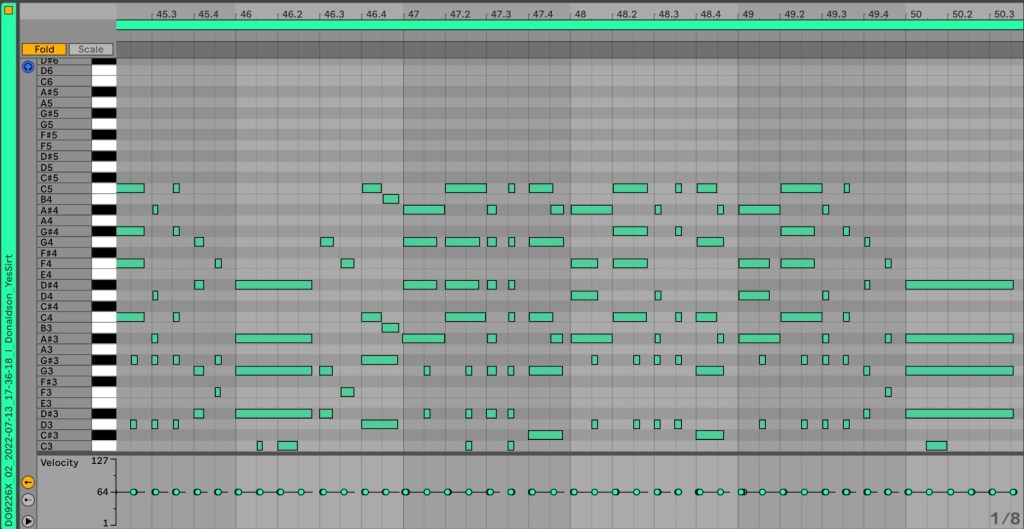
The subproject includes the digitization of piano rolls and the development of a tool to analyze (micro-time) structures on piano rolls: Microtime Machine. For the digitization process, the perforations of each piano roll are photographed digitally and then converted into MIDI files. These, in turn, can be visualized and listened to with a standard piano roll editor of digital audio workstations. Microtime Machine was built with Max for Live for Ableton Live, and provides functions for analyzing time patterns encoded in the piano rolls of our collection or on any MIDI file. Through this digital humanities approach, Subproject I elucidates the specific ways in which time structures were present on piano rolls.
The digital humanities approach is complemented by other methods such as the assessment of archival materials and discourse analyses of historical text documents (magazines, periodicals, autobiographies, player piano producers’ materials) as well as a media archaeological investigation of player piano interfaces and piano roll production devices.
 Sonische Moderne
Hinterlasse einen Kommentar